The Ceiling on an Electric Dirt Bike Is a Balance Point
An electric dirt bike top speed is not a number a motor simply produces. It is the point where the drive force still available at the rear wheel falls to meet the resistance pushing back - air drag, rolling friction, gradient and grip. Move rider mass, pack voltage, gearing or the surface and that crossing point moves with it. The limit is an equilibrium, not a specification.

Why electric dirt bike top speed is a balance, not a spec
Two curves decide where acceleration stops. The supply curve describes how much turning force the wheel can still deliver as it spins faster, and it slopes downward. The demand curve describes how much force the air, the tyres and the ground take back, and it slopes upward. Where the two lines cross, net force reaches zero and the machine holds a steady pace instead of gaining more.
Thinking in curves explains something a single figure cannot: two bikes with identical published ceilings can behave very differently on the way there. A machine with a shallow supply curve keeps pulling late, while one with a steep demand curve runs out of push early. The crossing point is the same; the ride is not.
The supply side: why drive force fades as the wheel spins faster
At a fixed pack voltage, a motor turning faster generates a counter-voltage that opposes the supply. The faster it spins, the less current the windings can draw, so torque tapers. That is the built-in downward slope, and it exists before any electronics intervene.
A controller adds a second boundary. It caps the current the motor may take, both to protect cells and wiring from heat and to keep the machine inside a chosen operating envelope. A low cap clips the top of the supply curve early; a higher one lets it extend further before falling away.
Pack state then shifts the whole curve downward. Under load, cell voltage sags, and the sag deepens as stored energy runs down or as cells get cold. A controller watching that voltage trims available current, so the crossing point arrives earlier in the afternoon than it did in the morning. Nothing mechanical has changed; the electrical headroom has.
Sustained heat does the same from the other direction. A controller worked hard on repeated climbs will reduce output to protect itself, and a rider reads that as a lower ceiling rather than a hot component.
The demand side: what the air and the ground take back
Resistance is not one thing. Aerodynamic drag is the part that grows fastest: it climbs with the square of speed, so each extra increment of pace costs disproportionately more force than the one before it. On a machine with an upright rider and knobbly tyres, that term dominates once the bike is truly moving.
Rolling resistance is steadier. It comes from the tyre casing flexing and from the surface deforming under it. Soft sand, wet clay and loose gravel all ask more from the tyre than hard-packed dirt, which is why the same setup settles at a different pace on each surface.
Gradient is a fixed subtraction. A climb takes a constant bite out of the force budget before drag is even considered, and the steeper the grade the sooner supply and demand meet. Rider and machine mass sit inside both rolling resistance and gradient: more mass to move means more force spent on everything except acceleration.
A deliberate cap is different from a physical one
Not every ceiling is reached by running out of force. Some are chosen in software. A selectable ride mode sets a hard limit below what the drivetrain could physically reach, and the controller simply declines to go further.
The Spark Racer 14 is the clearest example in this range: it ships with three selectable speed modes, so a parent can set a low ceiling for a first outing and raise it as skills grow. The hardware is unchanged between modes; only the permitted envelope moves. That is a supervisory tool, not a performance figure.
That distinction matters when reading a listing. A governed number describes a setting. A measured number describes one run under one set of conditions. Conflating the two is the fastest way to draw the wrong conclusion from a comparison table.

Which limit is binding on your ride?
Use the symptom to find the curve that moved. The table below maps what a rider notices to the layer responsible and to the response that actually helps.
| What you notice | Which layer moved | Why the ceiling changed | What actually helps |
|---|---|---|---|
| Pace drops gradually as the session runs long | Supply, pack state | Voltage sag trims available current | Start with a full pack; store it temperate |
| The bike feels strong on dirt but flat in sand | Demand, rolling resistance | Soft ground absorbs more force at the tyre | Tyre pressure and tread matched to the surface |
| Acceleration stops at exactly the same point every run | Governed speed mode | A software cap sits below the physical limit | Raise the mode only when the rider is ready |
| Pull fades after several hard climbs | Supply, thermal headroom | The controller protects itself by reducing output | Allow cooling time; avoid repeated max-load pulls |
| A heavier rider reaches a lower pace on the same stretch | Both curves at once | More mass to move and more rolling loss | Match machine and load to the rider |
None of these rows is fixed by a bigger number on a spec sheet. Each one points to a condition, a setting or a piece of ground, and those are the things a buyer can actually check.
How to audit a published electric dirt bike top speed
Before two figures can be compared, they have to describe the same test. Ask for the conditions behind the claim:
- Which ride mode was selected, and is the figure governed or measured?
- What rider mass, grade and surface were used?
- Was the pack full, and at what temperature?
- What gearing and tyre pressure were fitted?
- Does the number describe a brief peak or a pace the machine can hold?
- Are the test conditions published at all, or only the headline value?
If a listing answers none of these, treat the figure as a label rather than a measurement. Ask the seller directly before ordering, and compare machines on fit, sustained pull and gearing instead. A single headline value cannot tell you how a bike behaves on the ground you actually ride.
Where the ApexWill range fits, and where you may ride
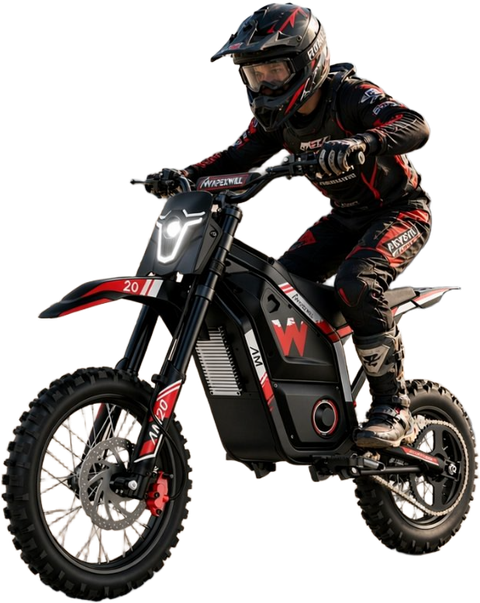
The AM20 is the mid-drive machine in the middle of the line, placing the motor at the crank so gearing shares the work with the rider. The AE30 is a moped-style bike built around adult proportions and a long wheelbase, which makes it a poor fit for a small first-time rider. The AE40 sits above both as the flagship of the range.
The full line is gathered in the electric dirt bike collection, where each model is listed with its current specification. The buyer's guide works through fit before any electrical figure, and a related explainer on what makes a bike feel quick covers acceleration rather than the ceiling. Check each product page for current pricing, since listed prices change over time.
None of these machines is street legal in the United States. Each one is built for off-road use only, and public roads, bike lanes, pavements and the paved link between two trails are off limits. A higher ceiling changes nothing about where the bike may be taken.
Lawful riding comes down to permission and ground: private acreage with the owner's consent, a pay-to-ride park, or land designated for off-highway vehicles. Rules differ between states and between the agencies that manage them, so confirm the specific area before loading up; the Bureau of Land Management off-highway vehicle programme is the starting point for federal land.
Protective equipment is not optional: a helmet, eye protection, gloves and boots that cover the ankle belong on every rider, and a young rider needs direct adult supervision on each outing. Charging deserves the same care - guidance from UL Solutions treats a matched charger on a hard, non-combustible surface as basic practice, and rider-safety material from the ATV Safety Institute is worth reading before a first season.

FAQ
What actually sets electric dirt bike top speed?
It is the point where the drive force still available at the wheel equals the force the air, tyres and ground take back. Supply falls as the motor spins faster and as pack voltage sags; demand rises with drag, rolling resistance and gradient. Gearing, rider mass, temperature and a governed speed mode all shift where those two curves meet.
Does a larger motor always give a higher ceiling?
No. A motor with more available torque can still be held back by a controller current cap, a low gear ratio, a governed mode or a soft surface that consumes the extra force at the tyre. The ceiling belongs to the whole system, not to one component, and the binding limit is whichever layer runs out first.
Why does my bike stop accelerating on a long straight?
Because net force has reached zero. As wheel speed climbs, the motor's counter-voltage reduces the current it can draw while drag grows with the square of speed. When the falling supply curve meets the rising demand curve, there is nothing left to accelerate the mass, so the machine settles at a steady pace.
Can a speed mode be changed later?
On models offering selectable modes, yes - the hardware stays the same and only the permitted envelope moves, so a parent can raise the ceiling as a young rider gains control. A governed cap is a setting, not a mechanical barrier. Raise it only when the rider has the gear, the ground and the supervision to match.
Can I ride one of these on public roads in the US?
No. Every model in this range is an off-road machine and is not street legal in the United States; roads, bike lanes, pavements and trail connectors on public land are closed to them. Riding is limited to private ground with the owner's permission, pay-to-ride parks and designated off-highway areas, with a helmet and protective gear and adult supervision for a young rider.
Find the layer that binds, then decide what to change.