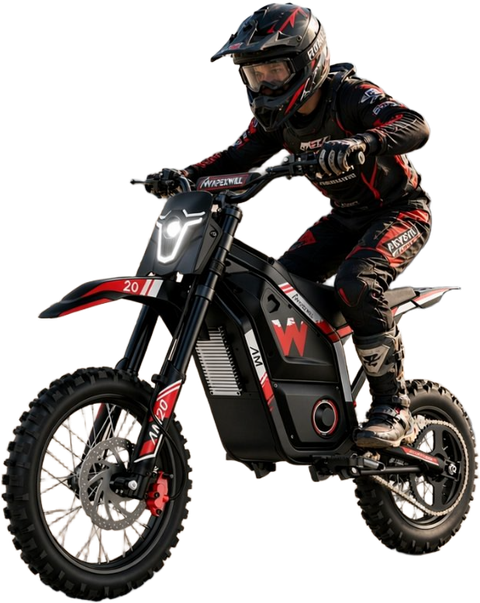
What Actually Decides How Fast an Electric Dirt Bike Feels
Speed on a fast electric dirt bike is a chain, not a number. Pull at one link - the controller's current limit, the final drive ratio, the pack's state of charge, the mass of rider and machine together, or the grip the ground gives back - and the same bike reads differently on the same afternoon.

What "fast" measures off-road
Off-road riding rewards two things and barely reaches the third. Acceleration out of a corner and the ability to hold a pace across broken ground decide most sessions. A straight-line ceiling rarely enters the picture, because a wooded trail or a rocky wash offers few places to use one.
A fast electric dirt bike spends its afternoon launching, braking and turning, not running flat out. That is why a machine mapped for hard launches feels quick everywhere a rider actually goes, while one set up for a high ceiling stays inert until it finds room it never gets.
Motor, controller and gearing: the links that set pull
Three parts decide how much of the pack's energy reaches the rear wheel as turning force. The motor converts electrical input into torque. The controller sets how much current the motor may draw at any instant. The final drive ratio trades that torque against wheel speed.
A controller with a low current ceiling is the most common reason a machine delivers less than its listing suggests. It protects cells and wiring from heat, and it does that by capping output exactly when a rider asks for the most. Two machines with comparable motors can feel nothing alike because of that single setting.
Gearing runs against intuition. A lower ratio multiplies torque at the wheel and gives up top-end, so it launches hard and runs out early. A taller ratio does the reverse. Off-road the lower ratio usually wins, because the surface rarely permits the speed the taller one sacrifices acceleration to reach.
Pack charge, temperature and voltage sag
A pack does not give the same output near the start of a session as it does near the end. As cells empty, their voltage under load sags further, and a controller programmed to protect the pack answers by reducing available current. The machine has not changed; the pack simply has less left to give.
Cold works through a different route to a similar end. Chilled cells resist current more, so a larger share of the energy leaves as heat inside the battery rather than reaching the motor. A rider who leaves a machine in an unheated shed overnight notices it on the first climb the next morning.
Heat is the same story from the far side. A controller worked hard on a long climb will cut back to protect itself, and that cut reads to the rider as a slow bike rather than a hot one.
Rider, load and terrain: the links you control
Everything above is fixed by the build. The next group of links is not, and these often move the result further than a spec sheet does.
| You want | Check this link first | What to change | Where you notice it |
|---|---|---|---|
| Quicker away from a standstill | Final drive ratio | Lower gearing, or less mass to move | Out of corners and on repeated starts |
| Stronger on long climbs | Sustained output, not the peak | Ask what the machine holds continuously | Mid-climb, where a cut would show |
| More stable on a loose surface | Tyre tread and pressure | Knobbier tread, a pressure that lets the casing work | Braking and cornering on gravel |
| Less fade late in a session | Stored energy and pack condition | A larger watt-hour pack, charged and stored properly | The last third of the afternoon |
| A number for a spec sheet | Nothing on this list | Read the measurement conditions instead | Nowhere a rider goes |
Mass deserves its own line. Rider and machine together are what the drivetrain has to accelerate, so a heavier rider on a machine with a modest output ceiling feels a difference that no gearing fully cancels. Published load limits matter here, and riding near them changes stopping distance as much as it changes launch.
Surface is the last link and the one most buyers forget. Loose gravel, sand and wet clay all return less of what the tyre asks for. A fast electric dirt bike that feels brisk on packed dirt can feel ordinary in a dry wash, with nothing at all wrong with it.

Why a headline top figure is a weak buying shortcut
A top number is measured under conditions most riders never meet: a hard, flat surface, a light rider, a full pack, no grade and no wind. Off-road, none of those hold. The figure is not false so much as unrepresentative, and two machines sorted by it can swap order the moment a rider adds weight, a hill or a loose surface.
When a listing gives a peak output and no sustained one, treat the gap as the real question. A peak describes a few seconds. The sustained figure, where a brand publishes it at all, describes the rest of the ride. Where it is not published, ask before ordering rather than filling the gap with an assumption.
Shopping for a fast electric dirt bike on that one number also skips fit, and fit decides whether a rider can plant both feet and reach both levers. Check each product page for current pricing rather than carrying a figure over from an old listing.
Where the ApexWill line sits
Built around adult proportions, the AE30 is a moped-style machine with a bench seat and a long wheelbase, so it is not sized for a young beginner. It suits a rider who would rather sit down across a long afternoon on open private ground.
The AE40 sits at the top of the line and carries the largest published pack in the range, so it belongs with an adult who already has ground to ride and the gear to ride there.
The AM20 is the dirt-bike-shaped machine in the middle, with a mid-drive layout that places the motor at the crank rather than inside a wheel.
The Spark Racer 14 starts the line for younger riders and offers selectable speed modes, so a parent can cap what the machine gives a beginner.
The whole off-road range sits in the electric dirt bike collection. The buyer's guide works through fit before any output figure, and the range guide covers how long a session lasts rather than how hard it starts.

Where you may ride, and who supervises
Extra capability buys no road access. Each machine here is built for off-road use and is not street legal in the United States. Public roads, bike lanes and sidewalks are closed to them, and so is the paved link between two trailheads.
Legal riding comes down to permission and ground: private acreage with the owner's approval, a pay-to-ride park, or a designated off-highway vehicle area. Rules vary by state and by managing agency, so check the specific area before loading up, and start with the Bureau of Land Management off-highway vehicle program for federal land.
Gear is not optional. Every rider needs a helmet, eye protection, gloves and boots covering the ankle, and a young rider needs direct adult supervision on every outing. Packs deserve the same care at the charging bench, and guidance from UL Solutions treats a matched charger on a hard, non-combustible surface as basic practice.
FAQ
What makes a fast electric dirt bike feel quick off the line?
A strong launch is mostly torque at the wheel, and that comes from the final drive ratio plus how much current the controller allows. A lower ratio and a higher ceiling both help a standing start, while a tall ratio set up for a high ceiling stays flat until it finds room a trail rarely gives.
Does a larger battery make an electric dirt bike faster?
Not directly. A bigger pack adds stored energy, which lengthens a session rather than sharpening launch. It can help indirectly, because a larger pack holds its voltage better under load and the controller cuts back later. Expect a longer afternoon, not a quicker start.
Is a fast electric dirt bike street legal in the United States?
No. Capability grants no access on public roads in the United States. These are off-road machines for private land with the owner's permission, a pay-to-ride park, or a designated off-highway vehicle area, and roads, bike lanes and sidewalks are all closed to them.
Why does my electric dirt bike feel slower as the pack drains?
Cell voltage sags more as a pack empties, and a controller protecting the cells answers by reducing available current. Cold cells resist current more, which turns more of the energy into heat inside the pack instead of sending it to the motor. Start sessions on a full pack and store the machine somewhere temperate.
What should I compare instead of a top speed figure?
Ask what output the machine holds continuously, what the final drive ratio favours, how much stored energy the pack carries, and whether the rider fits with both feet down. Those four shape a session. A peak measured on flat ground with a light rider predicts little about a climb or a loose surface.
Pick the link you can change, then choose the machine.