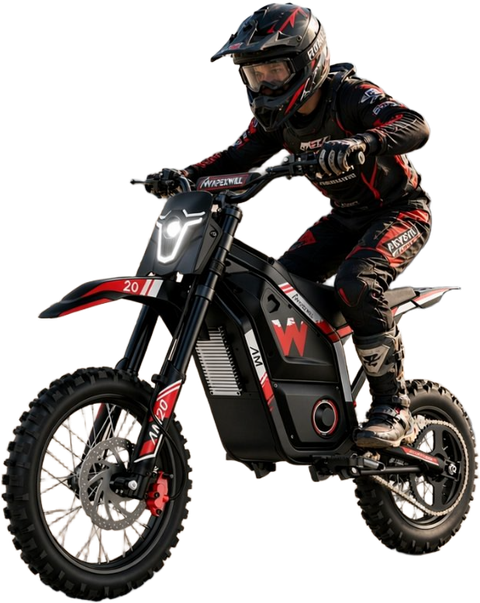
How to Pick the Right Electric Dirt Bike for Adults
Fit decides this purchase, not output figures. Choose an electric dirt bike for adults by matching seat height to the rider's inseam, confirming the rider can lift the machine alone, then matching the chassis to the ground actually available. Every machine discussed here is built for private land and designated off-highway vehicle areas rather than public roads.

Why adult riders shop differently
Adults shop against themselves rather than against a growth chart. A parent buying for a nine-year-old expects the machine to be outgrown in two seasons; an adult expects theirs to still fit in five years, which pulls the decision toward fit, serviceability and running cost and away from whatever sounds quickest on a listing.
The second difference is consequence. A full-size machine is heavy enough that a rider who goes down on a slope may not get it upright without help, and an adult riding alone is often farther from a truck, a phone signal and a second pair of hands than a supervised youngster ever is. Weight is therefore a safety specification, not a convenience one.
The third is honesty about terrain. Adults buy the riding they picture, then ride the riding they have. Picking for imagined weekends produces a machine that is too tall, too stiff and too heavy for the acreage or trailhead actually within reach on a Saturday morning.
Four fit checks that settle most of the decision
Four physical tests settle more of this purchase than any spec sheet, and all four take about five minutes on a flat garage floor.
- Both feet down, machine upright. Sit on the seat on flat ground and confirm both feet reach the floor. Tip-toe footing is acceptable on a dirt bike and miserable in a rocky section where the rider stops on a slope with the bike leaning uphill.
- Levers reachable without sliding forward. Grip both brake levers and check the rider is not perched on the nose of the seat to do it. That forward slide is what puts a rider over the bars on a loose descent.
- The lift test. Tip the machine onto its side and raise it unaided, from the ground, in one motion. If that is not possible on a clean floor, it will not happen on a hillside with a hot motor and a dead battery.
- One-person loading. If the machine has to travel in a truck bed or up a ramp, prove that the rider can do it alone. A bike that needs two people to load tends to stay home.

Match the machine to the ground you actually ride
Ground comes before specification. Read the row that matches the riding available this season, not the row that sounds most ambitious.
| The riding an adult really has | Surface | What it punishes | Check first | Stop worrying about |
|---|---|---|---|---|
| Acreage and paddock loops on private land | Grass, packed dirt, gentle grades | Boredom, numb hands, a hard seat | Seat comfort, upright riding position, tire pressure | Peak output claims |
| Fire road and double-track, 30 to 60 minutes | Loose gravel, shallow ruts | Wrist and back fatigue | Suspension at both ends, knobby tread | Travel numbers quoted alone |
| Tight single-track through roots and rock | Off-camber, constant steering | Low-speed balance, clearance | Ground clearance, brakes at both ends | Headline range in miles |
| Steep, technical climbs | Rock and loose surface at low speed | Lost traction, motor heat | Low-speed control, tire compound | Seat height alone |
| Riding alongside children on private land | Flat, open, predictable | Noise, supervision load, tyre grip | Rider fit, quiet running, adult supervision | Anything sized like a race machine |
The pattern worth noticing is that output never appears in the "check first" column. It is the number listings lead with and the number that decides least.
The listing numbers that survive contact with dirt
Three figures dominate off-road listings, and each is recorded under conditions that dirt riding breaks simultaneously: flat ground, moderate pace, a light rider, mild weather and no climbing.
Peak output is a burst figure rather than a sustained one. Top pace comes from the same controlled test, on a surface a trail never offers. The headline range figure assumes that same easy day, and loose ground, elevation and a heavier rider each take a share out of it.
What holds up instead: pack capacity in amp-hours and volts, brake type at both ends, tire type, suspension at both ends, seat height against inseam, total weight, and the published intended use. The cost of a replacement pack belongs on the same list, since a battery reaches the end of its life well before a frame does. The range guide breaks down each variable that moves that number, and the choosing guide covers the wider decision for riders still weighing up the category.
Dirt-bike shape or moped-style shape
Two chassis shapes sit under the same off-road brief, and they suit different days.
A dirt-bike-shaped machine puts the rider on a saddle with pegs, in an attacking stance, with long-travel suspension and knobby tires as standard equipment. It favours standing up over rough ground, climbing and riding technical sections at low speed. The moto-style versus dirt-bike comparison lays out the trade in full.
A moped-style machine uses a bench seat and footrests, sits the rider lower and further back, and carries a longer wheelbase. It favours sitting down for an hour at a time, carrying a passenger on private land where that is permitted, and covering open ground comfortably. It gives up some agility in tight, technical ground.
Neither is a road machine. Both are off-road shapes, and the choice between them is about how the rider prefers to spend an afternoon rather than about which is better.
Where an adult can legally ride
Every machine in this class is built for off-road use, so in the United States that rules out highways, bike lanes and sidewalks — and the short connector between two trailheads counts as a road too.
What replaces a licence is permission and a legal place to use it: private land with the owner's say-so, a pay-to-ride park, or a designated off-highway vehicle area. Which of those applies, and what paperwork or spark arrestor it requires, changes from one state and one managing agency to the next, so check the specific area before loading up. The Bureau of Land Management's off-highway vehicle program is the starting point for federal land, and the ATV Safety Institute runs rider courses worth finishing before a first season. The detail behind those road rules is set out in the street-legal guide.
Gear is not optional at adult size or adult pace. Helmet, eye protection, gloves and boots that cover the ankle, on every ride, with a second rider along on anything remote.

Which ApexWill machine fits which adult rider
Work from the rider, then the ground, then the shape.
The AM20 is the dirt-bike-shaped option: a mid-drive chassis with suspension at both ends, off-road tires and hydraulic disc brakes, sized as a full-size off-road machine. It suits an adult who wants to stand up over rough ground and ride technical sections. It is not a step-up machine for a five- to eight-year-old rider, and that is the honest limit of the chassis.
The AE30 is the moped-style alternative: a bench seat and footrests on a longer wheelbase, built around adult proportions. It suits a rider who would rather sit down across a long afternoon on open private land. It is not sized for a child.
The AE40 sits at the top of the range on both price and output, which makes it the wrong first machine for a young child and the right one only for a rider who genuinely needs the extra headroom.
Check each product page for the current price and the published fit figures before deciding; the electric dirt bike collection shows the full-size machines side by side.
The first month, in order
- Charge the pack fully on a hard, non-combustible surface, away from a wooden floor or a rug.
- Prove both brakes on flat ground ahead of the first descent, not during it.
- Set tire pressures for the surface and carry a puncture kit and a basic tool roll.
- Ride the first three sessions on ground already known, and add difficulty only after that.
- Tell someone the route and a return time, and take a partner on anything remote.
FAQ
What size electric dirt bike does an adult need?
An adult needs a machine the rider can flat-foot on the seat and lift unaided from its side. Seat height against inseam and total weight decide more than wheel size. A rider who cannot touch the floor with both feet, or cannot right the bike alone, will struggle on any slope.
Are electric dirt bikes for adults street legal?
No. Across the United States these count as off-road machines, so legal riding means private land with the owner's permission, a pay-to-ride park, or a designated off-highway vehicle area. Roads, bike lanes and sidewalks are all off limits, including the short connector between two trailheads. Each state and land agency sets its own requirements, so confirm the rules for the area you plan to use.
How much range does an adult rider need?
Plan in hours of riding rather than in distance. Repeated climbing on loose ground drains a pack far faster than the same time on flat fire road, and published range numbers assume flat ground, moderate pace and a light rider. Compare capacity in amp-hours and keep a margin.
Do adults need a licence to ride off-road?
On private land with the owner's permission, generally no licence is required. Public off-highway vehicle areas may ask for a registration, a permit, a spark arrestor or an age limit depending on the state and the agency managing the land. Rules differ by area, so confirm with the managing agency before travelling.
What should an adult check before the first ride?
Charge on a hard surface, prove both brakes on flat ground, set tire pressures for the terrain, and carry a puncture kit. Wear a helmet, eye protection, gloves and boots covering the ankle. Ride known ground first, tell someone the route and a return time, and take a partner on remote loops.
Fit the rider first, then the ground, then the chassis.