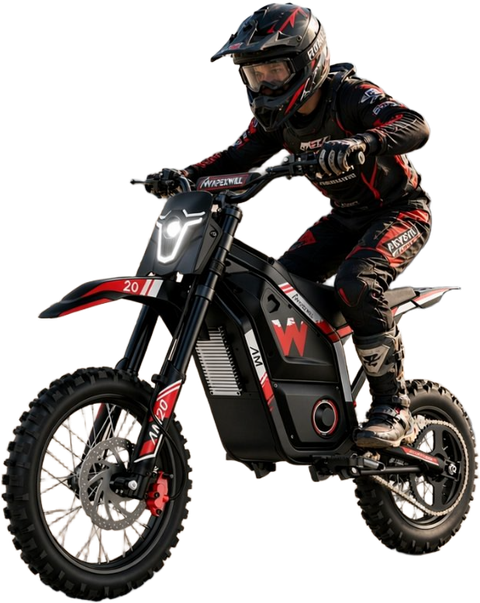
E Moto Street Legal 2026: What US Law Actually Requires
Searches for e moto street legal 2026 rules keep climbing, and the answer is unglamorous: a machine is street legal only when a state vehicle code gives it a class, a title path and a plate, and only when the machine meets that class's equipment list. ApexWill builds and sells every machine in this line for off-road and private-land riding, not for public roads.
Why "street legal" is decided by your state, not by the listing
Street legality is a state decision. Federal law defines one narrow category — the low-speed electric bicycle — and leaves mopeds, motorcycles and off-road machines to the fifty states.
Federal consumer-product law sets that low-speed electric bicycle definition: operable pedals, an electric motor of no more than 750 watts, and a motor-only speed cap of 20 mph on level ground. The statute is published by the U.S. Government Publishing Office, and the Consumer Product Safety Commission handles the product-safety side of it.
Everything outside that definition is state business. Most states run a three-class e-bike system, then define moped or motor-driven cycle separately, then define motorcycle, then decide whether off-road machines get a trail permit instead of a plate. County and city ordinances add another layer: sidewalks, bike lanes, shared-use paths and neighbourhood streets are often restricted locally even where state law says nothing.
That layering is why one page says "yes, it's legal" and the next says "no, it isn't". Both can be correct in different states, for different machines.
What has to be true before a state will issue a plate
Four things must line up before a state plates an electric two-wheeler: a recognised class, paperwork carrying a vehicle identification number, the equipment that class requires, and a rider holding the right licence.
- Class. E-bike, moped or motor-driven cycle, or motorcycle. If a machine fits none of them, there is nothing to register.
- Paperwork. A manufacturer's certificate of origin with a VIN, then a title application, registration, a plate, and in most states liability insurance.
- Equipment. DOT-marked tyres, a headlight and brake light, a mirror, a horn, and in the motorcycle class usually turn signals and a speedometer. Knobby off-road tyres generally carry no DOT marking.
- Rider. A licence with the correct endorsement, plus a helmet where state law requires one by age.
Where electric motos actually land: four buckets
| Bucket | What the law calls it | Paperwork the rider carries | Typical outcome for an electric off-road machine |
|---|---|---|---|
| Low-speed electric bicycle | Operable pedals, motor of no more than 750 watts, 20 mph motor-only cap | None in most states — no title, plate or insurance | Usually fails: dirt models have no pedals, knobby tyres carry no DOT marking, and off-road modes sit above the cap |
| Moped or motor-driven cycle | Small motor, limited speed, pedals sometimes required | Title, registration, plate, insurance, licence endorsement, helmet | Possible only where the state will title that VIN and the machine passes an equipment inspection |
| Motorcycle, on-road | Full-size motor, no pedal requirement | Title, registration, plate, insurance, motorcycle endorsement, full DOT equipment | Rare for electric off-road builds: no DOT lighting, no DOT tyres, no on-road VIN path |
| Off-road or OHV only | Not a road vehicle | Trail permit or off-highway decal where the state offers one | The honest bucket for ApexWill machines: private land with permission, and designated off-road areas |
Read the table from the top down. The first bucket a machine fails decides the outcome, and most electric motos fail the first on tyres, pedals or lighting, then fail the second and third on paperwork — an off-road machine ships without an on-road title path.
Why "off-road only" is the accurate label for this category
Electric motos usually miss road legality on equipment and paperwork, not on power: no DOT lighting, off-road tyres, no mirror or horn, and a certificate of origin that states off-road use. That is the wording behind the contradictory e moto street legal 2026 pages now ranking for this query.
ApexWill builds and sells four machines — the Spark Racer 14, the AM20, the AE30 and the AE40 — for off-road and private-land use, and sells none of them as a street-legal vehicle. A mode name printed on a product page does not change how a state classifies the machine, and an off-road mode is for private land.
Where riding is legal is a shorter list than most buyers expect: private land with the owner's permission, pay-to-ride parks and motocross tracks, and designated off-highway areas run by land agencies such as the Bureau of Land Management, which set their own permits and seasonal closures.

The 20-minute check that settles your own state
Run these five steps in order and you finish with a written answer rather than a forum opinion.
- Find your state's definitions. Start from the USA.gov motor vehicle services directory to reach your DMV, then search its site for "low-speed electric bicycle" and "moped".
- Read the equipment list for that class. Lighting, mirror, horn, tyre markings and brake requirements are usually itemised line by line.
- Ask the DMV in writing. Send the exact model, VIN and certificate-of-origin wording, and keep the reply on file.
- Check the rider requirement. Licence class, minimum age, and whether a helmet is mandated for that age.
- Check local rules. City ordinances cover sidewalks, bike lanes and park paths; forests and public land set their own trail classes.
If the answer comes back no, ask the same office about an off-highway vehicle permit or decal. That is the legitimate paperwork for a machine ridden off road, and in many states it funds the trail system you are riding on.
What riding on the road anyway actually costs
Riding an unregistered off-road machine on public roads usually costs more than the machine: a fine, towing and impound fees, no insurance cover after a crash, and liability that reaches the rider's household.
Insurance is the part riders miss. A homeowner or auto policy generally excludes a motor vehicle that cannot be registered, so the rider — or the parent who signed for it — pays the damage bill personally. Add the exposure of riding after dark without DOT lighting, on tyres not built for pavement, and the arithmetic stops being close.
Where ApexWill fits, and what these machines are not
ApexWill builds off-road electric machines across three sizes, and the useful buying rule is short: buy for the ground you can legally ride, not for the road.
- The Spark Racer 14 is the kids' machine — small wheels, three adult-selectable speed modes, published for riders aged 5+ inside its height and load limits, with adult supervision and a helmet required on every ride.
- The AM20 is a full-size dirt bike with a mid-drive motor, hydraulic disc brakes and trail suspension, built for teens and adults on rutted ground.
- The AE30 and AE40 are moped-style machines with a bench saddle, pedals and gears, sized for adults riding seated across open private land.

The trade-off, stated plainly: none of these machines is sold as a street-legal vehicle. They carry no DOT lighting or DOT-marked tyres, most states offer no title path for them, insurance will not cover road use, and a young rider still needs adult supervision plus a helmet and guards. A road commute is the wrong job for this hardware.

Start from the electric dirt bikes collection if the rider will stand on the pegs, or the moto-style e-bikes collection for seated miles, and treat each product page as the current source for stock and fit detail. For an e moto street legal 2026 question, the only answer that holds up is the one your own DMV puts in writing.
Frequently Asked Questions
E moto street legal 2026: can I register one for the road?
In most states, no. Registration needs a class the machine fits, a certificate of origin carrying a VIN, and the equipment that class requires. Off-road electric machines usually fail on tyres, lighting and paperwork long before motor output enters the conversation.
Does a 750-watt motor make an e moto street legal?
No. Federal consumer-product law uses 750 watts as one part of the low-speed electric bicycle definition, but that definition also requires operable pedals and a 20 mph motor-only cap, and states still decide registration, licensing and equipment rules.
Where can I legally ride an off-road electric dirt bike?
Private land with the owner's permission, pay-to-ride off-road parks and motocross tracks, and designated off-highway areas that admit this class of machine. Public roads, sidewalks, bike lanes and shared-use paths are out unless a state has titled and plated that machine.
Do I need a licence or insurance for off-road riding?
On private land, usually neither, though parks and tracks set their own entry rules and often require a signed waiver with a guardian present for a minor. On public land, check the managing agency for permit, age and seasonal rules before you load the machine.
What gear does a young rider need?
A full-face off-road helmet, eye protection, gloves, boots with ankle coverage and knee and elbow guards, plus adult supervision on every ride. A cycling helmet such as the RideShield covers the skull but leaves the jaw and face exposed, so treat it as a minimum for gentle ground.