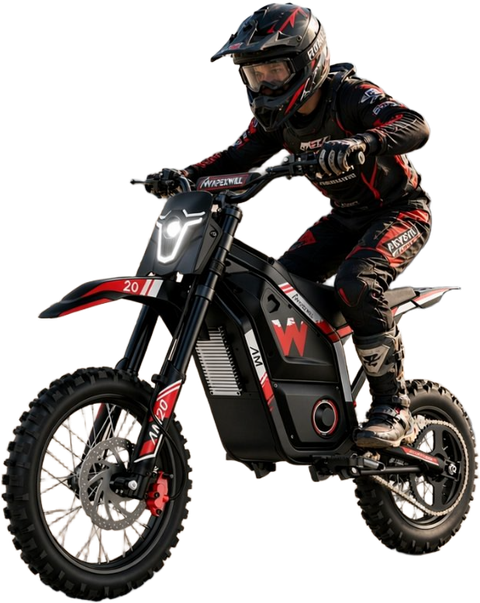
What a 48V Electric Motorcycle Actually Delivers
A 48V electric motorcycle runs on a lithium pack rated at 48 volts nominal, which is thirteen cells wired in series. That figure sets electrical pressure, and together with the amp-hour rating it sets stored energy. It says nothing about road access.

Where the 48V figure comes from
Thirteen lithium cells in series are what produce the 48V label. Each cell rests near 3.7 volts at half charge, so thirteen of them land at roughly 48 volts, and the very same cells reach about 54.6 volts when the pack is full.
That single fact explains a confusion that trips up almost every shopper in this class. One page prints 48V and another prints 54.6V for what is physically the same battery. The lower number is the nominal rating used to name the pack; the higher one is the full-charge voltage a charger stops at. Neither figure is wrong, and a buyer who knows only one of them will assume two different machines are being described.
The class name also carries a practical meaning. Riders searching 48V electric motorcycle are usually describing a moped-style machine with a long saddle, footpegs and a twist throttle, not a pedal-first bicycle with a battery bolted to the frame. ApexWill builds that shape for off-road use, which is why the voltage question lands here rather than on a commuter page.
There is one more reason the 48V band matters: parts. Chargers, controllers, connectors and replacement cells at this voltage are produced in volume, so a 48V electric motorcycle is far easier and cheaper to keep running than a machine built at an odd voltage nobody stocks.
What 48 volts delivers: the energy behind the label
Volts only become useful once they are multiplied by amp-hours. The product is watt-hours, the stored energy that caps how long a session can run, and it is the only figure worth lining up between two packs.
ApexWill lists the AE30 replacement battery at 48V nominal and 22.4Ah, which multiplies out to about 1075 Wh of stored energy. Measure the same cells at the full-charge 54.6V figure instead and the arithmetic reaches near 1223 Wh, which is exactly why capacity claims drift from listing to listing. Nominal is the convention, so apply it to both sides of a comparison or the numbers mean nothing.
ApexWill publishes up to 41.8 miles for the AE30 on a single charge. Set against 1075 Wh that is roughly 26 watt-hours per mile, a best case on level ground with a light rider, and it is the anchor for every estimate below.
Turning 1075 watt-hours into an afternoon
| Riding scenario | Assumed consumption | Estimated distance | What the session looks like |
|---|---|---|---|
| Level private ground, light rider, steady throttle | 26 Wh per mile | about 41 miles | Two long outings before a recharge |
| Rolling single-track, adult rider, mixed throttle | 38 Wh per mile | about 28 miles | One full afternoon |
| Soft ground and repeated climbs, heavier rider | 58 Wh per mile | about 18 miles | One hard morning |
| Learning laps with constant stops and starts | 50 Wh per mile | about 21 miles | One coached session with breaks |
Those rows are estimates built from the published best case, not measured test results. Rider mass, tyre pressure, ground surface and throttle habit each move the real figure, and cold weather moves it further. The range guide works through which of those variables costs the most.

What 48 volts does not decide
Four things that matter more than the label sit entirely outside it, and all four should be settled before two machines are ranked by voltage.
- How hard a machine drives. Motor design, gearing and the controller's current limit set that. None of them appear in a pack's name.
- How well it stops. Brake type and rotor size are their own purchase decision, and they decide whether a rider can haul up on a loose descent.
- Whether the rider fits. Seat height and reach decide that. A moped-style machine built around adult proportions will not fit a child, whatever the voltage.
- Where it can be ridden. No pack voltage grants access to a public road in the United States.
48V in context: 36V, 48V and 60V compared
| Pack label | Cells in series | Nominal volts | Full-charge volts | Where the class shows up |
|---|---|---|---|---|
| 36V | 10 | 36 | 42 | Small kids' machines and short supervised sessions |
| 48V | 13 | 48 | 54.6 | Moped-style and mid-drive machines built for full sessions |
| 60V | 16 | 59 | 67 | Listed more often than owned; more pressure, less current |
Voltage climbs with cell count, not with quality. A 60V pack carries more electrical pressure and asks for less current to do the same work, which keeps a harness cooler. It does not automatically carry more energy, because the amp-hour figure has an equal say in that calculation.
Charging and living with a 48V pack
A charger has to match the cell count and the connector of the pack it feeds. ApexWill publishes no output voltage, output current or charge time for the AE30 charger, so confirm the electrical match with support before ordering rather than assuming two parts from one brand interchange. For contrast, the Spark Racer 14 charger is published at 100-240 V input and 1 A maximum with a 42.8 V maximum charge voltage, figures that belong to that model's own 36V pack.
Pick a hard, non-combustible surface — concrete or tile, never a rug or a timber deck — and stay in the room while the pack fills. Unattended overnight charging appears again and again in lithium-ion incident reviews, and UL Solutions treats a matched charger on a clear surface as basic equipment practice.

Where the ApexWill AE30 fits
The AE30 is the machine in the ApexWill line built around a 48V pack, listed at 54.6V and 22.4Ah on the product page and at 48V nominal on its replacement battery. It is a moped-style machine with Shimano 7-speed gearing, hydraulic brakes, suspension at both ends, an alloy frame and a published maximum load of 150 kg.
That combination suits riders who want long trail sessions rather than short supervised laps, and it sits in the moto-style e-bike collection alongside the larger AE40. Check the product page for current pricing, since pack size and price do not move together.
The boundary worth stating plainly: it is a moped-style machine built around adult proportions and it is not sized for a child. A younger rider belongs on a smaller machine from the kids' end of the range. Every rider on this one needs a helmet, eye protection, gloves and boots that cover the ankle, and the machine itself is off-road only.
Where a 48V machine may be ridden
Off-road only and not street legal in the United States means public roads, bike lanes, sidewalks and the tarmac link between two trailheads are all out of bounds. Pack voltage changes none of that.
What does work is permission plus suitable ground: private acreage with the owner's approval, a pay-to-ride park, or a designated off-highway vehicle area. Rules differ by state and by managing agency, so check the specific area before loading up, and start with the Bureau of Land Management off-highway vehicle program for federal land.
Young riders need direct adult supervision on every outing, plus the full kit listed above. None of those requirements shift with the voltage printed on the pack.
FAQ
Is a 48V electric motorcycle street legal?
No. Pack voltage grants no road access whatsoever. ApexWill machines are off-road only and not street legal in the United States, which excludes public roads, bike lanes and sidewalks. They belong on private land with the owner's permission, a pay-to-ride park, or a designated off-highway vehicle area.
How far does a 48V electric motorcycle go on one charge?
It depends on stored energy rather than on the voltage alone. A 48V pack at 22.4Ah holds about 1075 Wh, and ApexWill publishes up to 41.8 miles for the AE30, which works out near 26 watt-hours per mile. Steep ground and a heavier rider can cut that by half.
Why do some pages list 54.6V for a 48V pack?
Both numbers describe thirteen cells in series. Each cell rests near 3.7 volts at half charge, giving the 48V nominal name, and near 4.2 volts when full, giving 54.6V. The first names the pack, the second is what a charger stops at, so the two figures are consistent rather than contradictory.
Is 48V better than 36V or 60V?
Better is the wrong question, because each class suits a different job. A 36V pack suits short supervised sessions on small machines, 48V suits full-length sessions on moped-style and mid-drive machines, and 60V trades higher pressure for parts that are harder to source. Compare watt-hours first, then availability of spares.
What should I check before buying a 48V machine for a teenager?
Start with fit, not electronics: both feet flat on the ground, both brake levers reachable, and a rider able to lift the machine unaided on a slope. Then settle adult supervision, a helmet, eye protection, gloves, ankle-covering boots and somewhere legal to ride. Then read the pack label.
Decide on the rider, the ground and the supervision first; the voltage only matters after those three are settled.